01
Operating Statement
A detailed statement of sales, operating income, direct expenses, indirect expenses, and profitability for past, estimated, and projected periods.
Professional Business, Tax & Compliance Solutions


CMA, or Credit Monitoring Arrangement, is a structured financial format used by banks to evaluate a business seeking working capital finance.
The report presents revenue, expenses, assets, liabilities, current performance, estimates, projections, and the proposed use of short-term and long-term funds.
The current ratio should generally be greater than 1.33.
Sales are generally expected to be four or five times the loan amount.
Calculation of Maximum Permissible Bank Finance.
Evaluation of liquidity, efficiency, and repayment capacity.
Financial analysis, projections, and working capital evaluation.
A CMA Report is a banker's critical evaluation of a loan applicant's current and projected financial statements. Applicants provide information about revenue, expenses, assets, liabilities, and obligations in the bank's required format.
CMA data systematically studies the borrower's working capital management. It helps the bank determine whether short-term and long-term funds are being requested and used for their intended purposes.
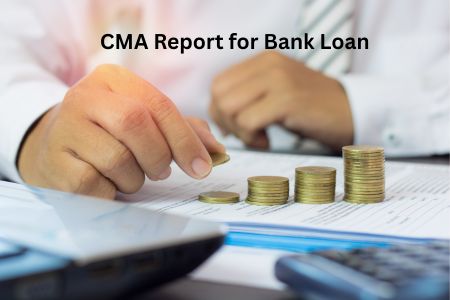
Banks review liquidity, sales, available stock, existing loans, receivables, collection periods, and the applicant's capacity to repay the proposed facility.
The current ratio should generally be greater than 1.33 to indicate an acceptable level of short-term financial strength.
The projected or existing sales should generally be four or five times the amount of the proposed loan.
The business should maintain sufficient stock that can support or act as collateral for the requested loan amount.
When the applicant already has another loan, the bank may require complete information about the status, balance, repayment, and terms of that loan.
Repayment capacity is evaluated using cash and bank balances, debtors, the collection period, working capital assets, and other relevant financial ratios.
The applicant generally submits an audited Profit and Loss Account and balance sheet for at least one year, estimates for the current year, projections for the next two years, a fund flow statement, ratio analysis, a comparison of current assets and current liabilities, and a statement showing the maximum amount of bank finance permitted.
The number of years for which data is required may differ from one bank to another. Updated CMA data may also need to be submitted periodically even after the finance facility has been sanctioned.
A detailed statement of sales, operating income, direct expenses, indirect expenses, and profitability for past, estimated, and projected periods.
A structured analysis of assets, liabilities, capital, borrowings, reserves, and the overall financial position of the applicant.
A comparative statement showing current assets and current liabilities to assess working capital requirements and liquidity.
Calculation of Maximum Permissible Bank Finance to determine the eligible level of working capital funding that may be provided by the bank.
A statement explaining the movement of funds and how short-term and long-term funds are generated and used by the business.
Financial ratios are calculated to evaluate liquidity, profitability, solvency, efficiency, collection performance, and repayment capability.
Financial records, projected statements, loan details, and relevant business legal documents are organised according to the bank's CMA format.
The applicant should provide an audited Profit and Loss Account for at least the previous financial year, or for the period requested by the bank.
An audited balance sheet showing the applicant's assets, liabilities, capital, reserves, and borrowings is required for financial assessment.
Estimated financial statements for the current year must be prepared based on actual performance, expected sales, expenses, and working capital needs.
Projected financial statements are generally prepared for the next two years, although the number of years may vary according to the bank's requirements.
Statements and repayment details of existing loans, credit facilities, outstanding balances, and banking arrangements may be required.
Business registration documents, PAN, GST records, ownership or partnership documents, bank statements, and other legal documents requested by the bank should be submitted.
Simplify your business journey with professional guidance for registrations, taxation, compliance, accounting, legal documentation, and financial advisory. Our experienced consultants help startups, MSMEs, entrepreneurs, and growing businesses stay compliant while focusing on growth.
From company registration to ongoing compliance, we provide complete business support under one roof.
Receive reliable advice from experienced professionals for tax planning, legal compliance, and business growth.
Fast Process • Transparent Pricing • Trusted Experts • Complete Business Support
Tell us about your business requirements. Our experts will connect with you shortly and recommend the right solution.